
Prices for telephony services
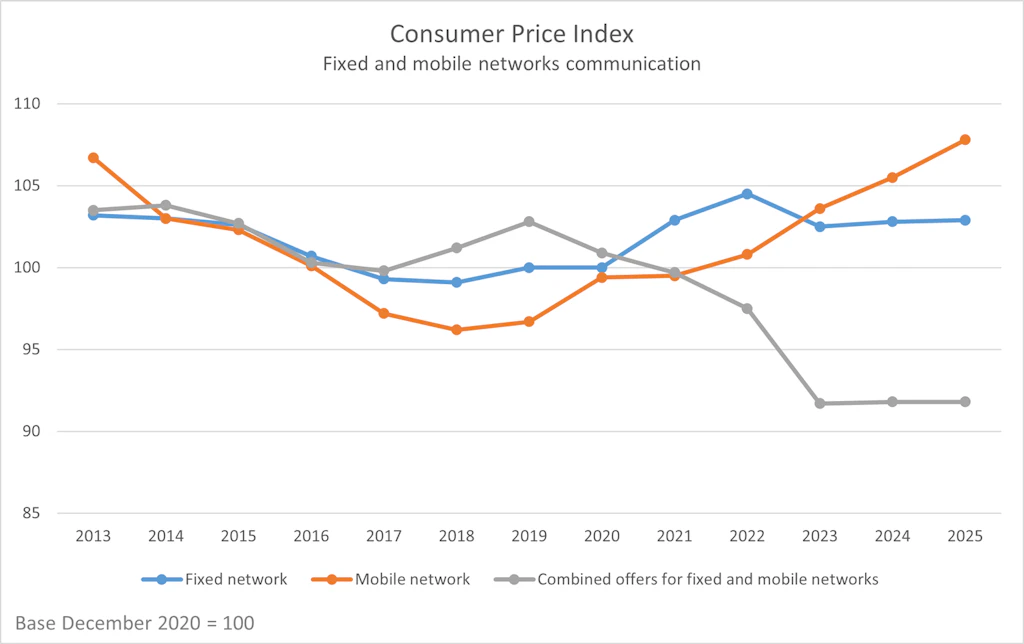
According to the National Consumer Price Index issued by the Federal Statistical Office (FSO), which measures price trends based on a basket of the principal consumer goods and services purchased by Swiss households, the overall index for telecommunications services rose by 0.9% between 2024 and 2025. This figure is significantly higher than the average inflation rate of +0.2% in 2025.
The increase is primarily due to higher prices for mobile communications, whose index rose by 2.2% last year. After several years of sharp decline, prices for combined fixed and mobile services, which are becoming increasingly popular with customers, have remained stable over the last two years (+0.1% in 2024 and 0% in 2025).
The mobile telephony prices covered by OFCOM’s Statistical Observatory, which are based on the lowest rates offered by providers on the Swiss market, reveal considerable differences. Regardless of the basket under consideration, the cheapest offer can be two to almost three times less than the most expensive.
The best offer for light phone users in 2025 (30 calls, 500 MB) was CHF 11.90 per month at M-Budget, which was about half the cost of the most expensive monthly offer, from Swisscom at CHF 23.
For medium usage consumers, the cheapest Salt offer (100 calls and 2 GB of data) at CHF 14.90 is almost 2.7 times cheaper than the equivalent Swisscom offer at CHF 39.90.
For customers with high usage needs (unlimited calls, 20 GB), despite a narrowing of the price gap since 2024, there is still a difference of almost CHF 27 between Salt’s cheapest offer at CHF 23 and Swisscom’s offer of CHF 50, which is more than twice as expensive.
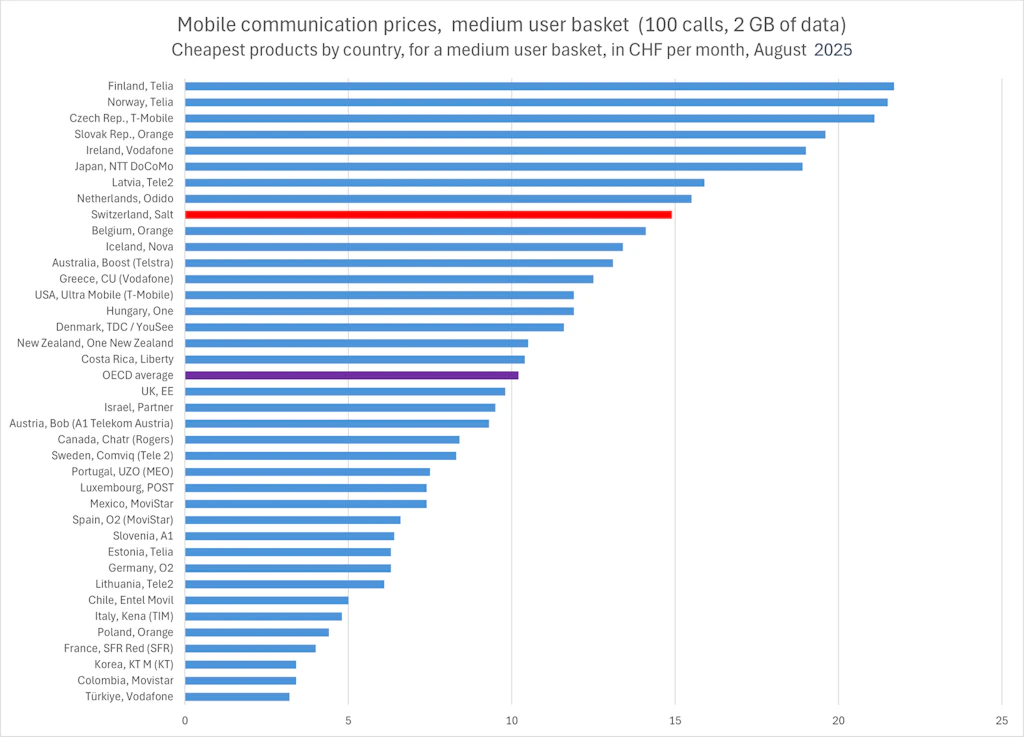
Mobile telephony prices in Switzerland are still among the highest internationally for the medium basket. This is confirmed by the price baskets published by OECD, which take into account the most competitive products offered by the largest carriers in each country.
The baskets for Switzerland factor in the three network operators Salt, Sunrise and Swisscom, as well as the secondary and tertiary brands Yallo and M-Budget. These include products and service options from both the prepaid and contract segments.
In August 2025, users in Switzerland paid CHF 4.20 more for an average basket (100 calls and 2GB of data connections) than the OECD-wide average (CHF 14.90 versus CHF 10.70). Measured in respect of the cheapest offer, Switzerland ranks 30st and thus falls within the top third of the more expensive countries. Only eight countries have higher prices.
In respect of small usage requirements (30 calls and 500 MB of data), Switzerland ranks 34rd, i.e. among the third most expensive OECD countries. In 2025, Swiss customers paid CHF 3.95 more than the OECD average.
Users in Switzerland paid CHF 0.60 more per month for a large basket (unlimited calls, 20 GB of data) than the average of OECD countries (CHF 23 versus CHF 22.40). This places Switzerland 12th in the rankings, among the mid-range of countries.