Published on 29 May 2026

Penetration rate

Broadband penetration in OECD countries (per 100 inhabitants, End of 2024)
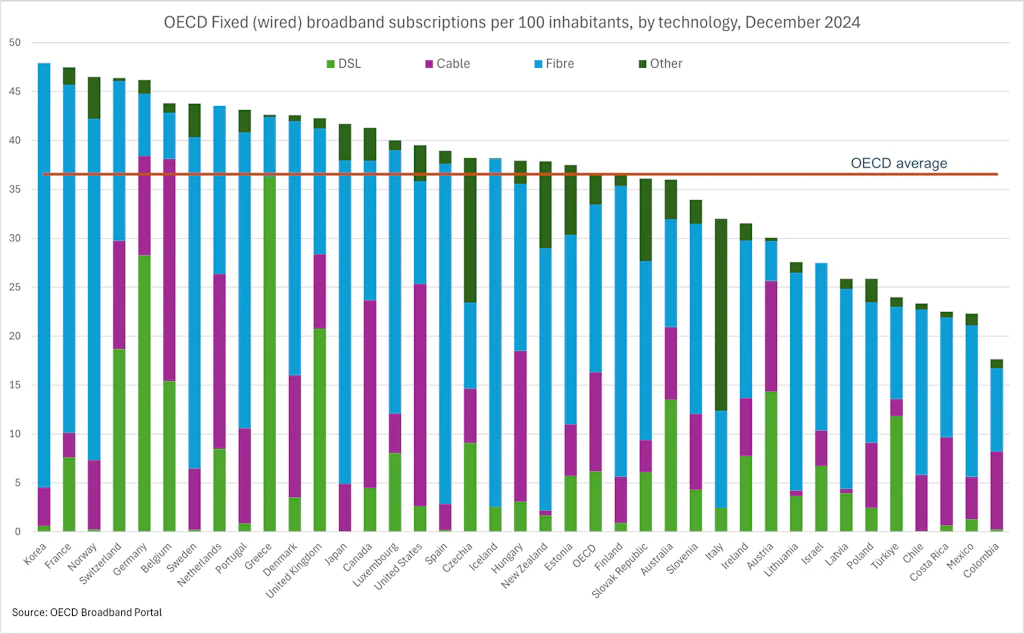
Stacked bar chart comparing the number of fixed broadband subscriptions per 100 inhabitants in OECD countries in 2024, broken down by technology. The horizontal axis lists the OECD countries. The vertical axis shows the number of subscriptions per 100 inhabitants (penetration). Each bar is divided into several segments corresponding to the technologies: DSL (light green), CATV cable (purple), fiber optics (blue), other technologies (dark green). A horizontal line indicates the OECD average, which stands at 36.5 subscriptions per 100 inhabitants. South Korea, France, Norway, and Switzerland are among the countries with the highest rates, ranging from 45 to 48 subscriptions per 100 inhabitants. Several Western European countries (Germany, Belgium, the Netherlands, Denmark, and the United Kingdom) also have high levels, generally above the average. The lowest penetration rates are observed in Colombia, Mexico, Costa Rica, Chile, Turkey, and Poland, with figures ranging from 18 to 26 subscriptions per 100 inhabitants. Fiber optics account for the dominant share in many countries, particularly in South Korea, Japan, Spain, and France. Cable (CATV) plays an important role in certain countries such as the United States, Canada, Belgium, and the Netherlands. DSL remains significant in several European countries, but tends to be less dominant.

Switzerland has a very high-performance broadband infrastructure. Thanks to competition between different infrastructure providers and services, the population benefits from a wide range of products.

Penetration rates.

Switzerland has a high number of broadband contracts for connections over the fixed network. At the end of 2024, 46.4% of the Swiss population had broadband internet access (regardless of the technology used). This makes Switzerland one of the best-connected countries in the OECD, ranking fourth behind South Korea (47.9%), France (47.5%) and Norway (46.5%). The average for OECD countries at that time was 36.5%.

Evolution of broadband connections in OECD countries. Top 7 leading countries, 2005-2024 (per 100 inhabitants)
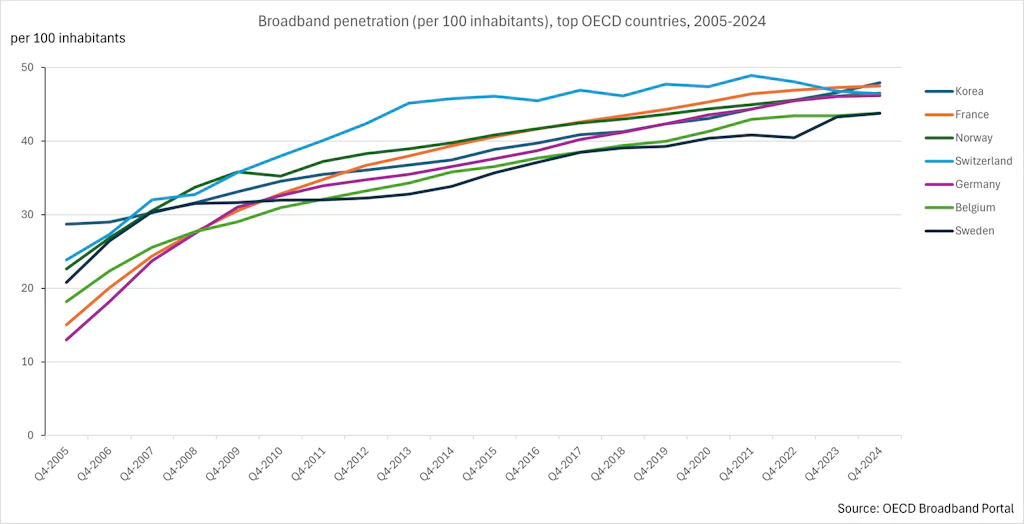
This line graph shows the evolution of the number of fixed broadband connections per 100 inhabitants between the end of 2005 and the end of 2024 in the seven OECD countries with the highest penetration rates at the end of 2024. The countries represented are: South Korea, France, Norway, Switzerland, Germany, Belgium and Sweden. In 2005, all countries had penetration rates between 13% (Germany) and 29% (South Korea). Since then, growth has been steady. Switzerland dominated for most of the period and remained in the lead until 2022. Switzerland was overtaken in 2023 and has occupied fourth place in the rankings since the end of 2024 with 46.40%, behind South Korea (47.90%), France (47.50%) and Norway (46.50%).