
Mobile data traffic
Growth in mobile data traffic
Mobile network data traffic also includes traffic generated by fixed wireless access (FWA) services
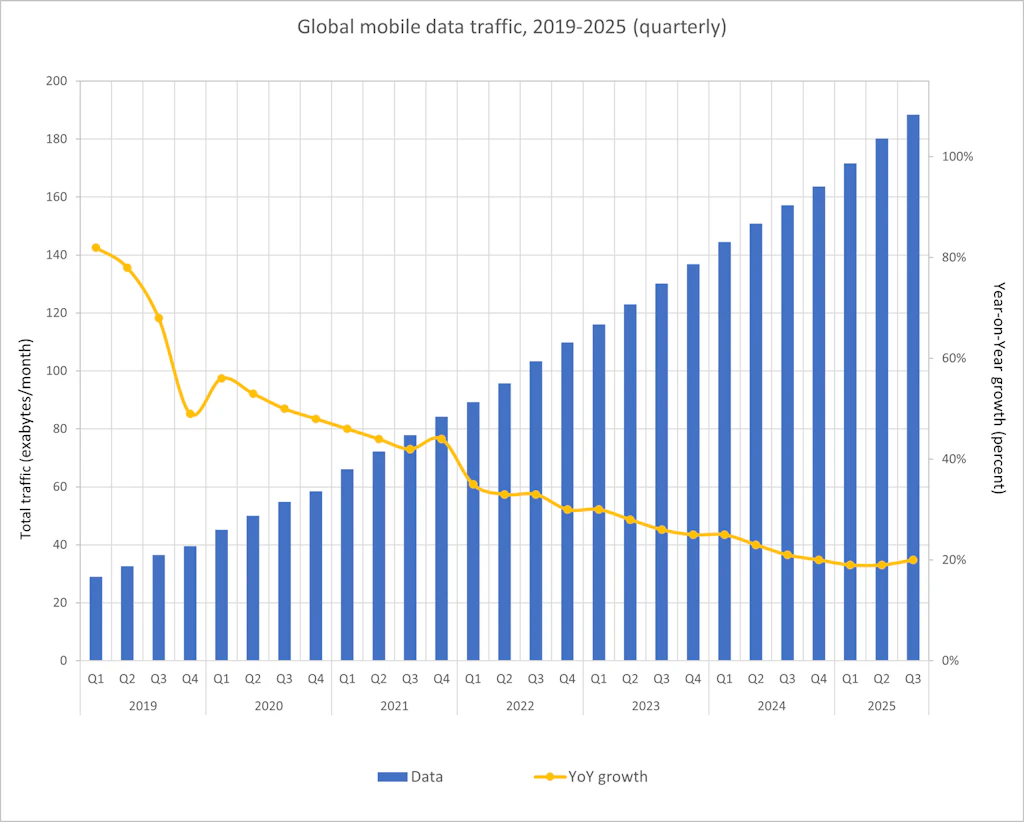
According to the Mobility Report published by Ericsson at the end of November 2025, global mobile data traffic continues to grow. Annual growth between the third quarter of 2024 and the third quarter of 2025 stood at 20%, slightly exceeding expectations.
Excluding traffic generated by fixed wireless access (FWA), this figure stood at 143 exabytes (EB) per month (143 billion bytes) at the end of 2025. Global mobile data traffic is set to increase 2.2 times by 2031, reaching 310 EB per month. If the traffic generated by FWA is included, the global monthly data volume at the end of 2025 was 197 EB and is expected to increase 2.4 times to 482 EB by 2031. In the third quarter of 2025, this volume was 188 EB, an increase of 5% over the previous quarter.
The volume of mobile data traffic is also continuing to rise in Switzerland. According to figures published by OFCOM, it reached a total of 2.36 billion gigabytes in 2024 (+12.7% compared to 2023).
According to Ericsson, the growth in mobile data traffic is driven by the rising number of mobile contracts linked to smartphones and an increase in the data volumes included in those contracts, which is mainly due to growing consumption of video content. Ericsson estimates that, by the end of 2025, video consumption accounted for 76% of mobile data traffic worldwide. The report also highlights the dominance of short video formats (‘shorts’) distributed via social media platforms: these account for 70 to 80% of the total data traffic generated by watching videos on smartphones.
The majority of mobile data traffic still uses earlier-generation networks, but the number of 3G and 4G subscriptions continues to fall, and 2G and 3G network shutdowns are progressing worldwide. Meanwhile, the share of 5G in mobile data traffic is increasing steadily. By the end of 2025, it was estimated at 43% (compared with 34% at the end of 2024). By 2031, this figure is expected to rise to 83% of global mobile data traffic.
The number of 5G subscriptions is also rising rapidly worldwide: by the end of 2025, there were around 2.9 billion, representing one third of all mobile contracts. This growth is expected to continue, meaning that 5G subscriptions are likely to account for two thirds of all contracts, or a total of 6.4 billion, by 2031.